
Cours offert en partenariat avec Avalanche Canada
Description du voyage
Come join us at the ACC clubhouse in Canmore, we'll provide a thorough introduction to avalanche basics and a framework with which to make decisions in the field. We cover the standard curriculum (as outlined by Avalanche Canada). By the end of the day, you will know how to identify avalanche terrain, complete an avalanche rescue and how to read the avalanche bulletin so that you can start planning your own backcountry adventures.
This course is tailored to those with little to no experience in avalanche terrain. Starting with the basics, you'll be introduced to the fundamentals of avalanche terrain and a framework to help make the best decisions while in the field. The course is open to anyone with an interest in how to safely travel in the backcountry, making it perfect for those looking to ski past the boundaries at the resort this winter!
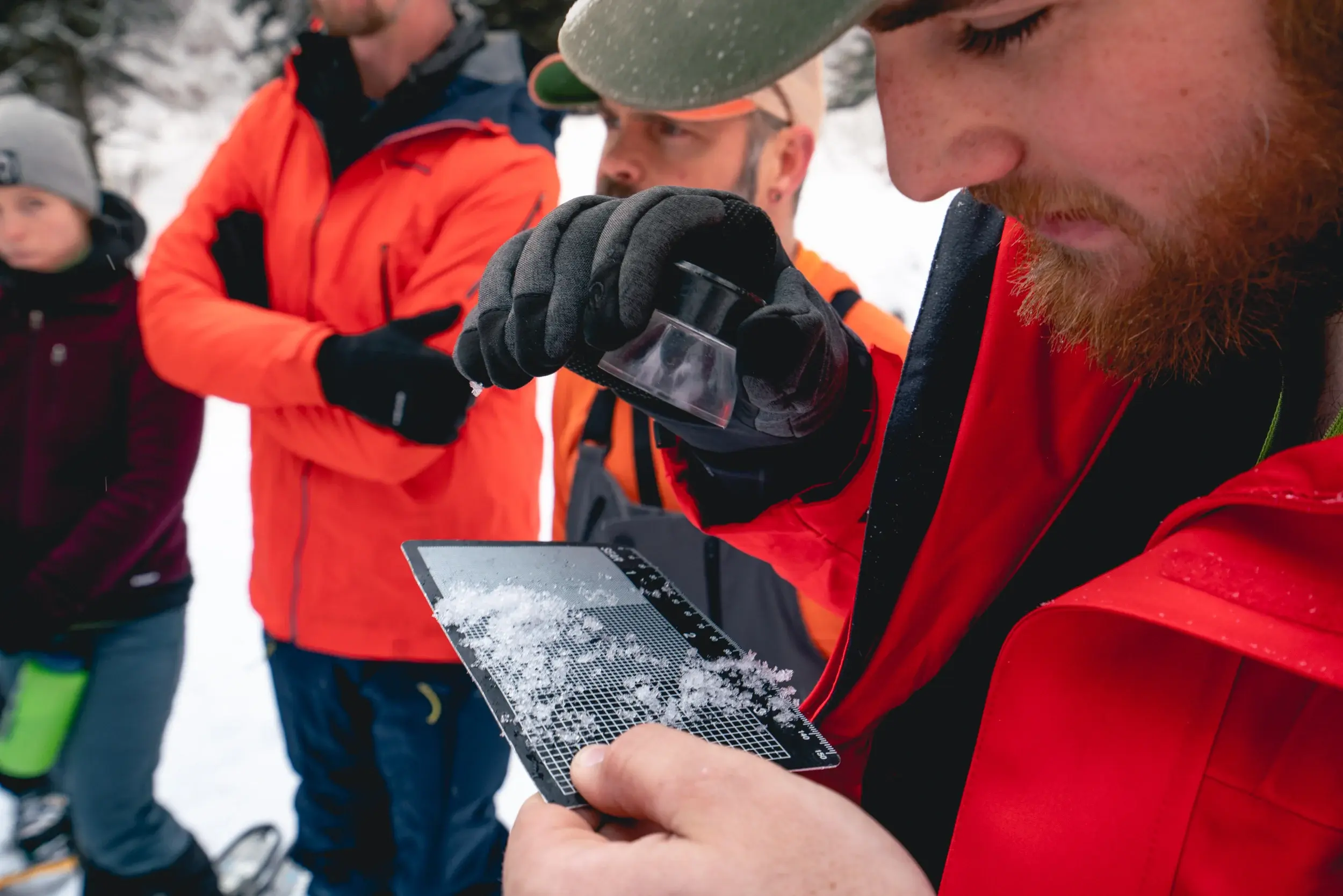
On the field day, you'll be led by expert instruction in small groups, allowing you the best hands on learning experience. Our small group ratios allow you to get the most out of the experience. All group gear such as first aid kits and emergency equipment will be covered. Please be sure to bring along your own avalanche safety kit (beacon, probe, shovel), as well as any food for the day. A complete gear list and equipment rental information can be found here.
Itinéraire
The ultimate goal of our avalanche training program is for you to make it home safely at the end of your future winter excursions. Our AST 1 course lays the foundations of travelling through avalanche terrain by focusing on the following topics:
- Introductory snow science
- Avalanche formation and release
- Identifying avalanche terrain
- Basics of trip planning
- Optimal use of tools and resources, like avalanche forecasts, to mitigate your avalanche risk
- Use of appropriate travel techniques in avalanche terrain
- Introduction to companion rescue
At the end of the course you will receive an Avalanche Canada certificate signed off by your instructor. This is a formal recognition of your training.
Day 1- Classroom (9AM - 6PM)
Participants meet at the clubhouse for 9am until 6pm with a break for lunch. Curriculum topics which will be covered this day include:
- Introductions, course goals, agenda
- Understanding avalanches: Formation and characteristics
- Avalanche terrain recognition Introduction to the ATES (Avalanche Terrain Exposure Scale)
- Changes in the mountain snowpack (i.e. snow metamorphism)
- Assessing and reducing risk
- Accessing public avalanche bulletins
- Using the AVALUATOR
- Safe travel choices and proper route planning
- Companion rescue techniques Discuss program for Day 2 in the field
Day 2- Field
Meet at the designated trailhead in Banff National Park or Kananaskis at 9:00 am MT. Today you will be making real-life observations and gaining hands-on experience. Curriculum topics which will be covered on this day include:
- Field observations
- Companion rescue techniques and practice
- Managing risk in avalanche terrain
- Route selection, track setting and terrain related hazard
- Snow profiles and stability tests
- Companion rescue scenario
- 4:30 pm - Course debrief, presentation of certificates
Our field day will see a maximum participant-to-guide ratio of 8:1 to make for the best possible learning experience!
Lieu
Bow Valley
Classroom learning will be held at the historic ACC clubhouse. On your field day you’ll head out to wherever the conditions are best. Whether that’s in Kananaskis, Banff National Park, or the iconic Bow Summit.
Nous vendons l'assurance voyage Tugo®, adaptée aux aventures du CAC comme aux voyages personnels.
En savoir plusDangers de l'aventure
-
Avalanche:
Les risques peuvent inclure, sans s'y limiter : Des avalanches peuvent survenir dans le terrain où nous évoluons et peuvent être causées par des forces naturelles ou par des personnes qui circulent dans le terrain (p. ex. ski/planche à neige). -
Communication, secours et traitement médical:
Les risques peuvent inclure, sans s'y limiter : La communication peut être difficile et, en cas d'accident, les secours et les traitements peuvent ne pas être disponibles. Les intempéries peuvent aussi retarder l'arrivée des traitements et le transport hors du terrain. Si une blessure survient dans un terrain difficile, le déplacement vers un point d'évacuation peut être lent. -
Terrain non contrôlé:
Les risques peuvent inclure, sans s'y limiter : Le terrain est non contrôlé, non balisé et non inspecté, et peut comprendre : corniches, crevasses, falaises, arbres, puits d'arbre, chablis forestiers et souches, ruisseaux, roches et blocs, trous et dépressions sous la surface de la neige, conditions de neige variables et difficiles, terrain de marche variable et difficile, chemins de chenillette et talus, clôtures et autres structures artificielles, enfouissement dans la neige, impact ou collision avec d'autres personnes, véhicules ou objets, variations extrêmes des sentiers ou du terrain, rencontres avec des animaux domestiques ou sauvages, perte d'équilibre ou de contrôle, glissades, trébuchements et chutes, ainsi que le fait de se perdre ou d'être séparé de son groupe. -
Autres risques:
Les risques peuvent inclure, sans s'y limiter : Glissades, trébuchements et chutes, tant à l'extérieur qu'à l'intérieur. Conditions météorologiques changeantes, y compris, sans s'y limiter, les vents violents, la foudre et les feux de forêt. Effets de la haute altitude, y compris l'œdème pulmonaire et l'œdème cérébral. Maladies infectieuses contractées par des virus, bactéries, parasites et champignons, qui peuvent se transmettre par contact direct ou indirect. Défaillance de l'équipement. Avertissements ou instructions incomplets. Premiers soins négligents. Négligence d'autres personnes, y compris le coordonnateur de la sortie et les autres participants. -
Systèmes de bottes et de fixations:
Les risques peuvent inclure, sans s'y limiter : Même correctement réglée, une fixation de ski peut ne pas se déclencher à chaque chute ou se déclencher de façon inattendue. Le système botte/fixation de ski ne garantit pas que le skieur ne se blessera pas. Les fixations non certifiées DIN, comme les fixations à inserts (pin/tech), présentent un risque plus élevé de déclenchement prématuré ou de blessure, car elles ne sont pas conçues selon les mêmes normes de sécurité qu'une fixation alpine certifiée DIN.
Contrairement aux systèmes botte/fixation de ski alpin, les systèmes botte/fixation de planche à neige et de certains télémarks ne sont pas conçus ni destinés à se déclencher et ne se déclencheront pas dans des circonstances normales. L'utilisation d'un tel système augmente le risque de blessure ou de mort en cas d'ensevelissement sous une avalanche.
À propos de vous
Personne à contacter en cas d'urgence
Confirmez ou mettez à jour votre personne à contacter en cas d'urgence pour cet événement.
Santé
Ces renseignements ne sont communiqués qu'à l'équipe qui coordonne votre aventure.
Comprend des maux de tête intenses, des nausées, des vomissements ou d'autres symptômes en altitude.
Veuillez inclure les allergies et intolérances environnementales, médicamenteuses, alimentaires, etc.
Anaphylactique = réaction grave nécessitant un auto-injecteur d'épinéphrine.
Profil d'aventure
Renonciation du CAC

The Alpine Club of Canada Waiver
Version 2.2
A valid ACC Release of Liability is required to participate in any ACC activities or events. Please read the following waiver carefully. ALL checkboxes must be checked in order to submit the agreement.
The Alpine Club of Canada – Minors Waiver
Version 1.1
A valid ACC Release of Liability is required for a minor to participate in any ACC activities or events. This waiver must be completed by the minor's parent or legal guardian. Please read the following waiver carefully. ALL checkboxes must be checked in order to submit the agreement.
Signature du parent ou tuteur requise
Vous n'avez pas atteint l'âge de la majorité dans votre province ou territoire. Nous avons besoin d'un parent ou tuteur légal pour signer cette renonciation en votre nom. Veuillez fournir leurs coordonnées ci-dessous.
En attente de la signature du parent
- Renonciation pour mineur du CAC
- Renonciation pour mineur AST
Renonciation AST
Avalanche Canada Release of Liability
Version 2.1
A valid Avalanche Canada Release of Liability is required to participate in any Avalanche Safety Training program facilitated by The Alpine Club of Canada
Avalanche Canada Release of Liability
Version 2.1
A valid Avalanche Canada Release of Liability is required to participate in any Avalanche Safety Training program facilitated by The Alpine Club of Canada
Révision et consentement
Conditions de participation
Consentements supplémentaires
J'accepte que le CAC utilise les photos ou vidéos de moi prises pendant le cours du CAC aux fins de ses publications et de son marketing. Je renonce à mon droit d'examiner ou d'approuver l'utilisation de mon image dans les médias du CAC. J'accepte également de ne réclamer aucune compensation au CAC si mon image ou ma vidéo est utilisée aux fins indiquées ci-dessus. Je libère le Club Alpin du Canada, ses employés, entrepreneurs, bénévoles et successeurs de toute réclamation pouvant découler de l'utilisation de mon image, y compris toute réclamation pour atteinte à la vie privée, violation des droits moraux, du droit à l'image ou du droit d'auteur.
Paiement