
Description du voyage
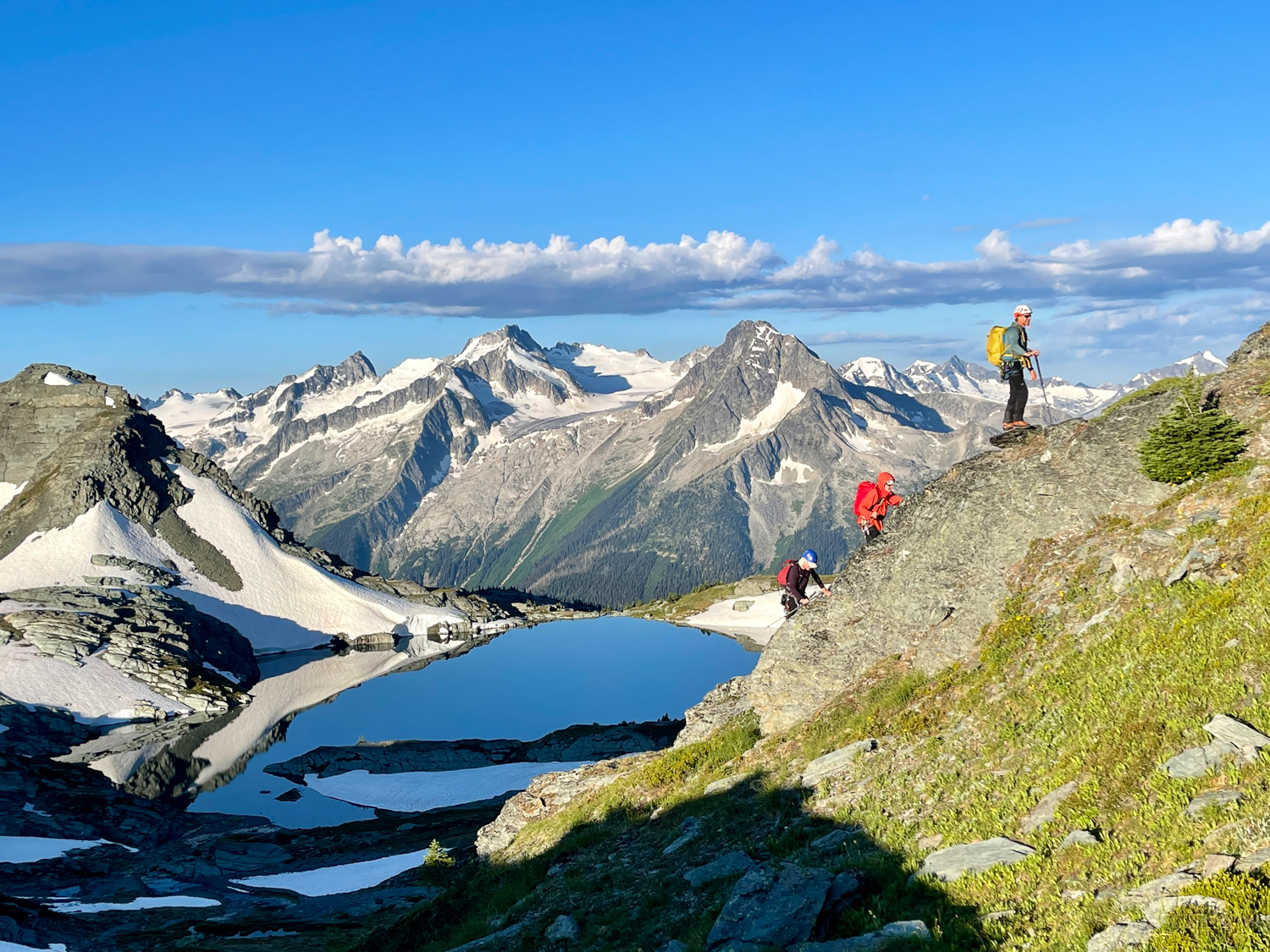
Each year, participants in the General Mountaineering Camp are flown by helicopter to a remote alpine location with a well-equipped base camp. There, they have the chance to learn new mountaineering skills, explore secluded alpine areas, and experience a unique, modern-day mountain adventure.
All our camp equipment, food, participants’ personal gear, and climbing equipment will be flown in by helicopter. During camp, all outings are under the supervision of ACMG-certified guides who will lead hikes and climbs, and provide instruction in all aspects of mountain craft. Your weekly attendance fee will cover the flight in and out, tent accommodation, guiding and instruction, sumptuous meals, and group climbing gear.
There will be refresher courses offered on glacier travel, alpine snow, and rock climbing. The GMC is an excellent place to learn new skills or refresh your existing mountaineering skills. Whether you are looking to explore a remote area, hope to stand on your first mountain, or to summit peaks, the GMC is your epic ‘summer camp in the mountains’.
Please note that this course is normally restricted to those over the age of majority, in the location the course occurs. Registrations for minors (accompanied by a parent/legal guardian) are considered on a case by case basis, please contact the office to learn more.
Itinéraire
The day’s objectives will vary for the different teams. Objectives for longer days will include climbing peaks, traversing ridges and other mountaineering routes.
Shorter days will include rock school, glacier skills days, and hiking days. The daily curriculum will be dependent on participants’ skills and goals.
All outings from camp will be under the direction of the guides. Many factors, including the weather, will determine how the days will play out. The focus of each day is fun, learning and exploration in the mountains.
Day one
We will meet early in the morning* at the participant rendezvous point in Golden, BC, before driving to the helicopter staging area. From the staging area, you and your gear will then be flown into the Trident basecamp. Upon arrival at the camp, you will greeted and oriented by the camp manager and assigned a sleeping tent. You'll also have the chance to meet some of the guides and to go on a short hike to explore the area close to camp this day.
*Rendezvous time and place will be confirmed in pre-trip email.
Day two onward (a typical day)
- 4:00 am early wake up horn for longer days
- 4:30 am early breakfast is served
- 5:00 am teams leave camp for longer days
- 6:00 am general wake-up call
- 6:30 am breakfast is served
- 7:00 am teams leave camp for shorter days
- 2:00-4:00 pm teams arrive back at camp
- 2:00-6:00 pm free time for swimming, showers, tea, etc. The choice of objectives for the next day is posted
- 6:00 pm supper is served
- 7:30 pm lunch building and preparations for the next day
Final day
After a final breakfast together, participants will have time to pack, take final photos, and say goodbye before the flight out. The helicopter is scheduled to land at camp around 11:00 am for return flights to the staging area. By approximately 3:00 pm, participants will be back in Golden.
Lieu
Trident Group - northern Selkirks
The Trident Group is located in the Northern Selkirk Mountains of British Columbia. The rock in the area is predominantly quartz-mica schist, mica schist, micaceous quartzite and speckled gneiss. The location offers easy access to spires, glaciated terrain, and alpine lakes and meadows. This is truly an alpine explorer’s paradise.
We appreciate that the lands known today as Canada are home to the enduring presence of all First Nations, Métis, and Inuit peoples and we acknowledge the past, present, and future generations of these Nations who continue to lead us in stewarding this land, as well as honour their knowledge and cultural ties to this place. The Trident Group is located on the Traditional Lands of the Sinixt, Syilx, Secwepemc, Stoney, Ktunaxa, and Confederated Tribes of the Colville Reservation.
Le campement
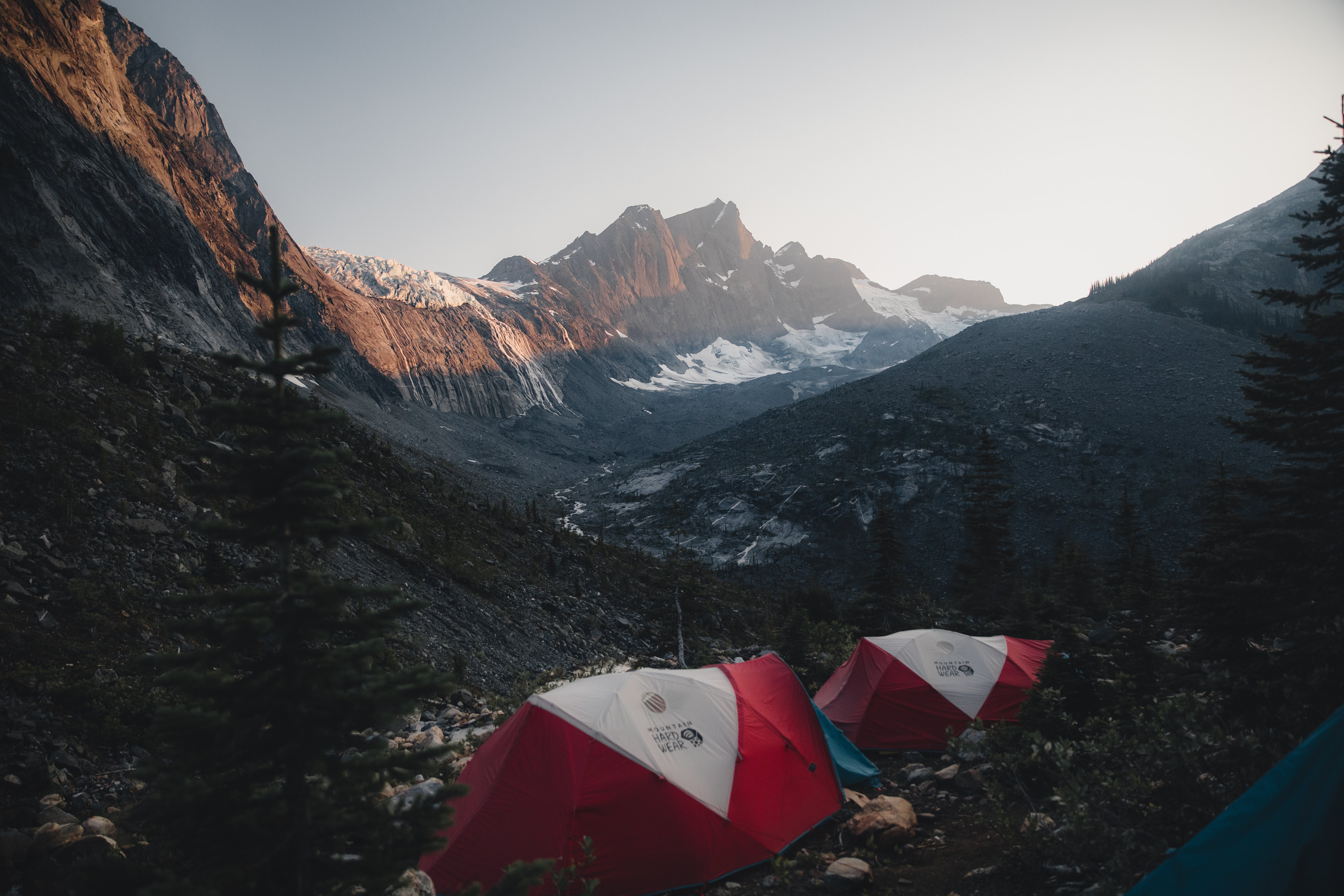
The Trident camp will enjoy all the standard facilities of the ACC’s GMC basecamp. The infrastructure of the camp will include helicopter access, sleeping tents (1 or 2 person tent), dining tent, drying tent, outhouses, and hot showers.
Food is always a highlight at the GMC. All meals are made from scratch on-site each day by our staff with fresh ingredients. We set up a full backcountry kitchen, complete with ovens, a BBQ, and three experienced chefs to prepare and serve your meals. We fly in and prepare fresh food from scratch – there’s never any dehydrated backpacking meals at the GMC!
Each week of the GMC is staffed with a camp manager, a team of certified guides, camp cooks, camp volunteers, and a camp doctor.
Nous vendons l'assurance voyage Tugo®, adaptée aux aventures du CAC comme aux voyages personnels.
En savoir plusCommanditaire(s) de l'événement
Nous remercions tous nos commanditaires pour leur soutien.

Dangers de l'aventure
-
Chutes de pierres:
Les risques peuvent inclure, sans s'y limiter : Les chutes de pierres peuvent être causées par des forces naturelles ou par des personnes qui circulent dans le terrain (p. ex. escalade/varappe/randonnée). -
Communication, secours et traitement médical:
Les risques peuvent inclure, sans s'y limiter : La communication peut être difficile et, en cas d'accident, les secours et les traitements peuvent ne pas être disponibles. Les intempéries peuvent aussi retarder l'arrivée des traitements et le transport hors du terrain. Si une blessure survient dans un terrain difficile, le déplacement vers un point d'évacuation peut être lent. -
Terrain non contrôlé:
Les risques peuvent inclure, sans s'y limiter : Le terrain est non contrôlé, non balisé et non inspecté, et peut comprendre : corniches, crevasses, falaises, arbres, puits d'arbre, chablis forestiers et souches, ruisseaux, roches et blocs, trous et dépressions sous la surface de la neige, conditions de neige variables et difficiles, terrain de marche variable et difficile, chemins de chenillette et talus, clôtures et autres structures artificielles, enfouissement dans la neige, impact ou collision avec d'autres personnes, véhicules ou objets, variations extrêmes des sentiers ou du terrain, rencontres avec des animaux domestiques ou sauvages, perte d'équilibre ou de contrôle, glissades, trébuchements et chutes, ainsi que le fait de se perdre ou d'être séparé de son groupe. -
Autres risques:
Les risques peuvent inclure, sans s'y limiter : Glissades, trébuchements et chutes, tant à l'extérieur qu'à l'intérieur. Conditions météorologiques changeantes, y compris, sans s'y limiter, les vents violents, la foudre et les feux de forêt. Effets de la haute altitude, y compris l'œdème pulmonaire et l'œdème cérébral. Maladies infectieuses contractées par des virus, bactéries, parasites et champignons, qui peuvent se transmettre par contact direct ou indirect. Défaillance de l'équipement. Avertissements ou instructions incomplets. Premiers soins négligents. Négligence d'autres personnes, y compris le coordonnateur de la sortie et les autres participants. -
Chutes et assurage:
Les risques peuvent inclure, sans s'y limiter : L'escalade de rocher présente le risque de chuter de la paroi, ce qui peut faire heurter au grimpeur la paroi ou le sol et entraîner des blessures ou la mort. Le risque de défaillance de l'assurage est également présent, ce qui peut contribuer au risque d'une chute au sol. La défaillance de l'équipement constitue aussi un risque, y compris l'équipement associé à l'escalade, à la descente en rappel et à l'assurage.
À propos de vous
Personne à contacter en cas d'urgence
Confirmez ou mettez à jour votre personne à contacter en cas d'urgence pour cet événement.
Santé
Ces renseignements ne sont communiqués qu'à l'équipe qui coordonne votre aventure.
Comprend des maux de tête intenses, des nausées, des vomissements ou d'autres symptômes en altitude.
Anaphylactique = réaction grave nécessitant un auto-injecteur d'épinéphrine.
Profil d'aventure
Renonciation

The Alpine Club of Canada Waiver
Version 2.1
A valid ACC Release of Liability is required to participate in any ACC activities or events. Please read the following waiver carefully. ALL checkboxes must be checked in order to submit the agreement.
The Alpine Club of Canada – Minors Waiver
Version 1.0
A valid ACC Release of Liability is required for a minor to participate in any ACC activities or events. This waiver must be completed by the minor's parent or legal guardian. Please read the following waiver carefully. ALL checkboxes must be checked in order to submit the agreement.
Signature du parent ou tuteur requise
Vous n'avez pas atteint l'âge de la majorité dans votre province. Nous avons besoin d'un parent ou tuteur légal pour signer cette renonciation en votre nom. Veuillez fournir leurs coordonnées ci-dessous.
En attente de la signature du parent
- Renonciation pour mineur du CAC
- Renonciation pour mineur AST
Révision et consentement
Conditions de participation
Consentements supplémentaires
J'accepte que le CAC utilise les photos ou vidéos de moi prises pendant le cours du CAC aux fins de ses publications et de son marketing. Je renonce à mon droit d'examiner ou d'approuver l'utilisation de mon image dans les médias du CAC. J'accepte également de ne réclamer aucune compensation au CAC si mon image ou ma vidéo est utilisée aux fins indiquées ci-dessus. Je libère le Club Alpin du Canada, ses employés, entrepreneurs, bénévoles et successeurs de toute réclamation pouvant découler de l'utilisation de mon image, y compris toute réclamation pour atteinte à la vie privée, violation des droits moraux, du droit à l'image ou du droit d'auteur.
Paiement